
Reliable data on our vital resource
Procedure

Monitoring the aquatic fauna means getting wet: Equipped with fishing boots, field workers wade through the water of smaller rivers and streams along a precisely defined section. The sediment is stirred up at several points and collected with a standard dip net, after which all of the aquatic invertebrates are separated out and identified at family level. This can be used to calculate various water quality indices.
This methodology is in line with the widely used modular step-by-step concept for macrozoobenthos – see box opposite. The larvae of the three insect orders mayflies, stoneflies and caddisflies are collected and identified down to species level in the laboratory by specialists. In addition, information on ecomorphology and water quality is also recorded at a measuring point, which provides further information for analysis.
Measuring point

The measuring point in a watercourse is shown in blue. The length of the section may vary depending on the situation.
Monitoring network

The monitoring network for surveying the diversity of aquatic insects comprises around 500 sections of around 5 to 100 metres in length in smaller watercourses.


Preparation

- Determining the annual sample
- Assembling field teams and determining workloads
- Adapting methodology guides for the field surveys, if necessary
- Adjusting the list of species authorised for the survey, if necessary
Instructions
- Launch events for the field teams for each species group: Notification of new developments, discussion of methodologically sensitive points
- Special instructions during the field season, especially with regard to weather conditions (safety aspects)
- Targeted educational events (e.g. identification of difficult species groups, further training, official verification)
Field work

- Field surveys according to regular methodology. Some of the sampling areas are surveyed twice for quality control by secondary groups.
- Vascular plants, butterflies, breeding birds: Observation and species identification on-site. Noting of species observations in the BDM app.
- Moss types, snails, aquatic invertebrates: Collecting of samples without further identification. For aquatic invertebrates, pre-sorting of samples on-site.
Dispatch of samples for further processing and identification
Laboratory work

Snails
- Washing and sieving of soil samples
- Sorting of snail shells
- Identification of snail shells at species level
Moss types
- Identification of moss samples at species level
Aquatic invertebrates
- Identification of aquatic invertebrates down to family level. Sharing of sample material for species identification
- Identification at species level for mayfly, stonefly and caddisfly larvae
Quality controls
- Plausibility checks on species identification, queries to field staff
- Calculation of routine key figures as indicators of data quality
- Evaluation of the consequences of methodological errors or deviations
- Decisions on the validity or invalidity of raw data
Data administration
- Import/entry of field data and laboratory protocols into a central database
- Checking the completeness of recordings and data records
- Incorporating decisions from quality control
- Documentation of all corrections to the raw data in a database log
Releasing and using data
- The revised data is declared valid and made available for data analyses
- Data analyses on current topics
- Calculation of further biodiversity indicators for the federal government and the cantons, e.g. legislative indicators, environmental indicators, contribution to the “Cercle Indicateurs”
- Data analysis by third parties, on request (e.g. universities)
- Data and species records are forwarded to the respective national data and information centre
Support in the field: recording app

Nowadays, it makes sense to record species in the field using a smartphone app. However, BDM has been recording data digitally for 20 years. In the beginning, it used Palm Pilot devices; today, field workers use standard Android smartphones. A crucial advantage from the outset: standardised data formats, species names and categories for all field workers, plus rapid data import. Vascular plant surveys in rural areas alone generate around 50,000 species observations every year across Switzerland! The app used was customised for the BDM and has been continuously developed since its first routine use in 2012. The app can be made available on request.
Procedure

In order to monitor vascular plants, mosses and gastropods in habitats, fieldworkers first localize each 10 square meter sampling site by means of a GPS device and a magnetic locator. Once the magnet buried at the center is found, the sampling site is delimitated using a piece of string of 1.8 meters of length.
Using the BDM smartphone app, plant species are recorded directly on the spot. While this usually eliminates the necessity of transferring field notes to a computer, some plants need to be collected for subsequent identification. Mosses and gastropods are always passed on to experts for identification.
Sampling area

The circular sampling area for terrestrial habitats is 10 square metres and is highlighted in orange above for clarity.
Monitoring network

The monitoring network for biodiversity in habitats comprises around 1450 measuring points, each 10 square metres in size. A distinction is drawn between forest, meadows and pastures, settlements, fields, alpine pastures and mountain areas as habitats. Vascular plants, moss types and snails are monitored.


An important addition to the number of species
The data from the BDM monitorings can be used to determine the average number of species in habitats and landscapes. But is this information sufficient to describe biodiversity in Switzerland in great detail? No, it's not! Relatively long species lists may be compiled for a particular habitat type or a particular region, but these may differ only slightly between the individual sampling areas. This indicates that such species communities are not particularly diverse. This fact is taken into account by the “Diversity of Species Communities” indicator, which compares the species lists of the sampling areas. Particularly high diversity is only achieved when as many species as possible occur per plot and the overlap of species lists between the sampling areas is low.Example of a simple calculation
The number of species is counted separately for each area. The indicator value is calculated from the mean value of these species numbers. To calculate the diversity of species communities, however, the species lists (presence-absence data) of two sampling sites are compared with each other. The proportion of different species is calculated using a diversity index commonly used in ecology, known as the Simpson Index.


The same procedure is used for all possible combinations of two sampling sites. The average of all calculated index values gives the indicator value. An indicator value of 1 means maximum diversity of the species communities. On a purely hypothetical level, this would occur if no species occurred in two compared sites. An indicator value close to 0 means that the species communities are very uniform. Although the calculation is simple in principle, on a computational level it is complex due to the various comparisons involved.
So what happens if the species composition changes over time? Two scenarios are set out below.
Procedure
-

Vascular plants
All species growing within 2.5 metres to the left and right of the path along a predetermined route (transect) are identified and recorded. The strip in question is wide enough to cover not only the edge of the path, but also the predominant land use (e.g. field, meadow, forest). Due to the location at the edge of the path, small-scale habitats such as embankments, copses and ruderal areas, which are important for the biodiversity of a landscape, are also recorded. The route is completed twice in an assessment year (exception: only one assessment is made in mountain areas). -

Butterflies
The transect followed for this taxon is also followed for vascular plants. Field workers identify all butterflies that fly past at a maximum distance of five metres. The app is used to log each observation with GPS coordinates. Depending on the altitude level, four to seven assessments are carried out per year. Each year, around 3,000 kilometres of transects are covered for BDM surveys on butterflies, and around 900 kilometres for vascular plants. Since the start of BDM, employees have covered over 70,000 kilometres for these two taxa! -

Breeding birds
The assessments of breeding birds are coordinated with the ornithological programme “Monitoring Common Breeding Birds”. Employees walk a transect measuring roughly five kilometres in length, along which they search a sampling area of one square kilometre as comprehensively as possible for the presence of breeding birds. Three morning excursions take place in the valleys and two morning excursions take place at higher altitudes in predetermined time slots.
Sampling area

Sampling area of one square kilometer for monitoring biodiversity in landscapes, with a marked transect (red line) for plant and butterfly assessments. The birds are monitored over the entire area as part of the monitoring of common breeding birds by the Swiss Ornithological Institute in Sempach.
Landscapes sampling network

The BDM sampling network for species diversity in landscapes consists of roughly 500 sampling areas covering 1 square kilometer each. It serves to monitor vascular plants, butterflies and breeding birds (by the Swiss Ornithological Institute), with 20% of the total surface being sampled each year. In the Jura and Southern Switzerland, the sampling network has been densified to obtain reliable data for these regions.


Hotspot Special Edition
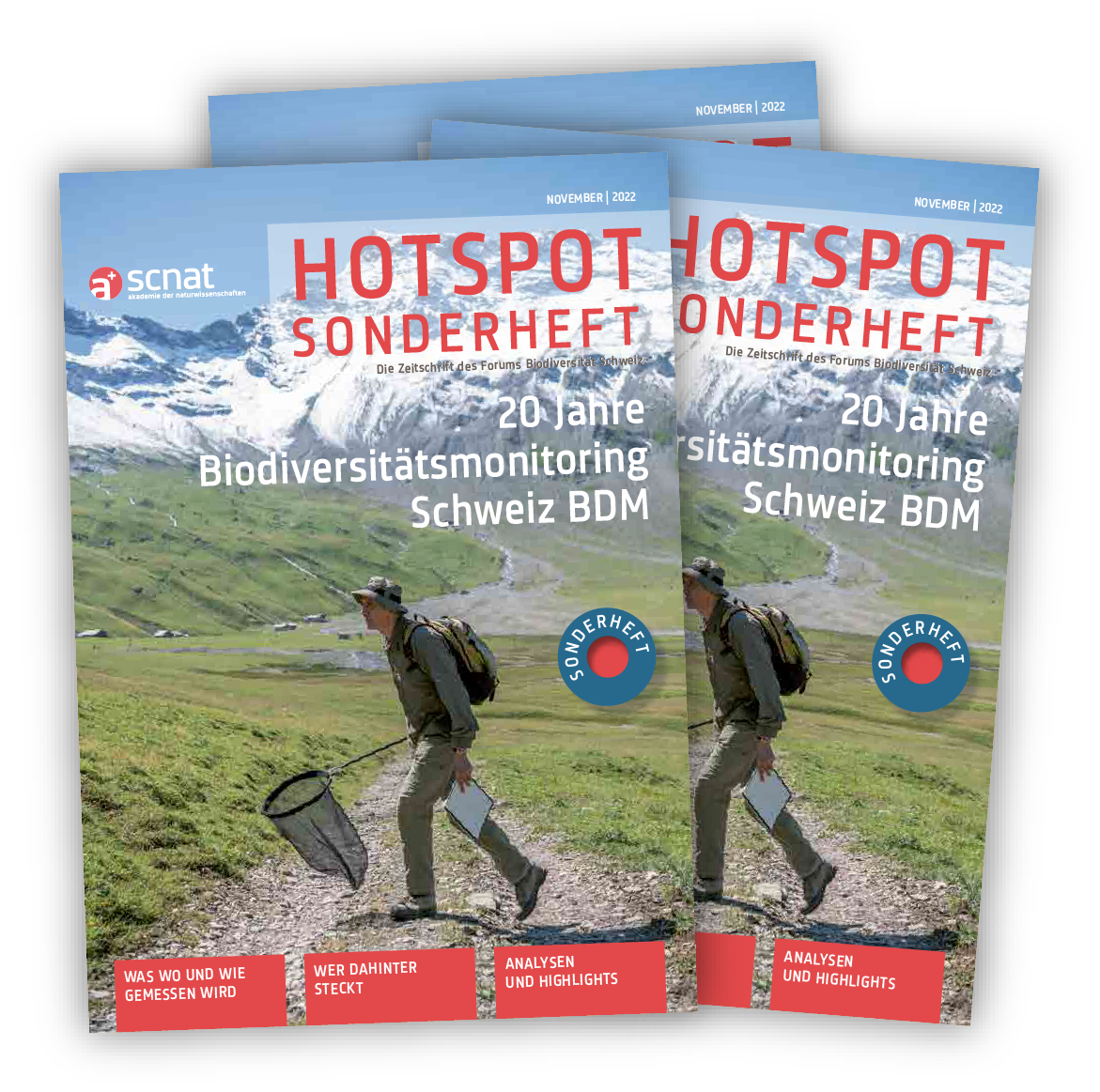
The Hotspot special edition on 20 years of BDM shows who works behind the data and highlights current developments in biodiversity.
Publications

Collection of all scientific publications with BDM data: